
Drafts and leaks in Tampa, FL
You can feel air along the edge of the panel, and after a hard rain there is water inside on the floor. In almost every case the seal has given up somewhere. The fuzzy pile weatherstrip on the stiles has flattened or shrunk, the interlock where the two panels meet is no longer closing tight, or the weep holes in the sill are blocked so water sits in the track instead of draining out. Often it is two of those at once.
Phones answered around the clock · free estimate
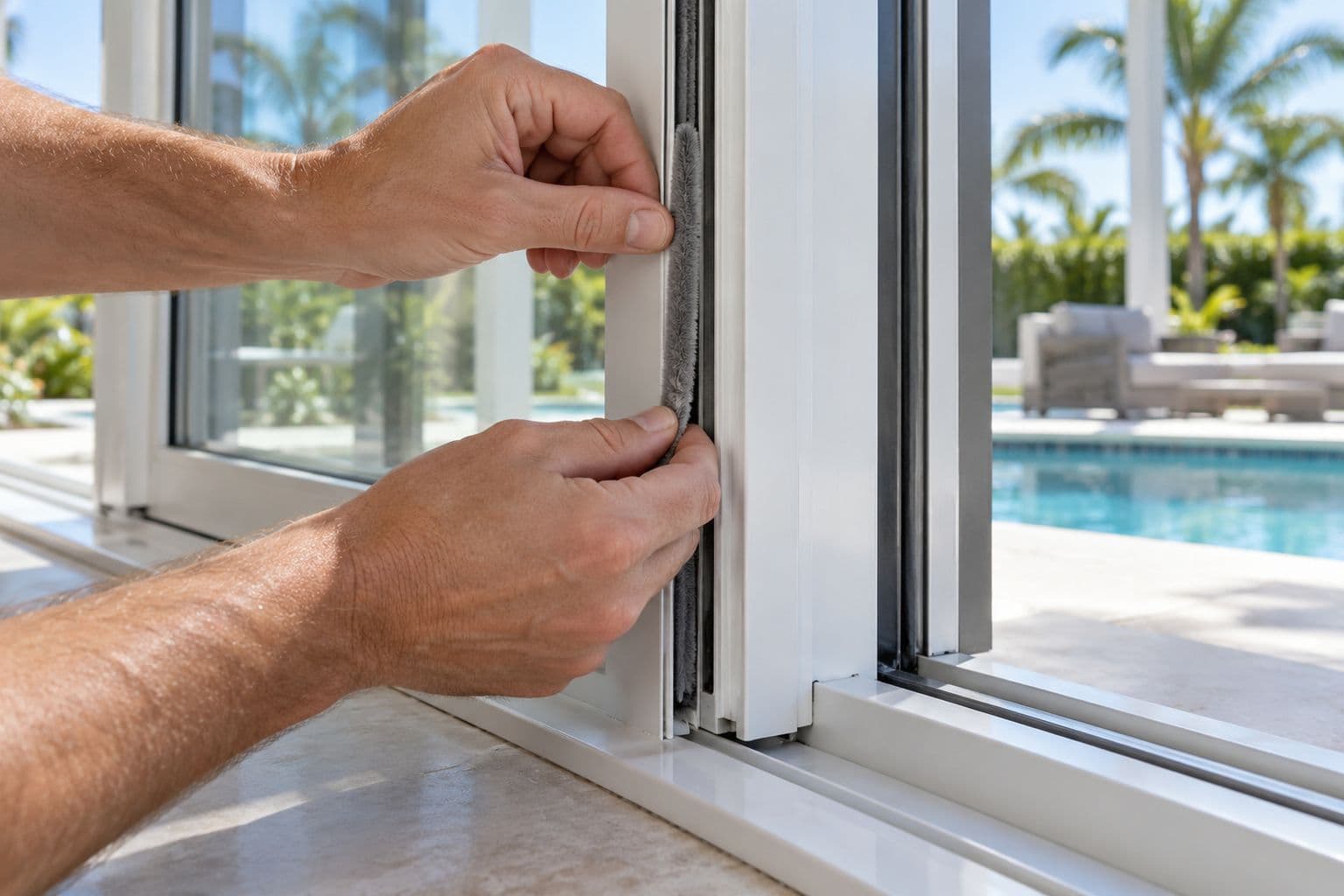
In Tampa that is normal wear, not bad luck. Florida sun degrades weatherstripping and vinyl parts until gaps open up, and the daily thunderstorm pattern from June through September pushes wind-driven rain straight at the sill. Add blown grit and heavy pollen packing the track, and salt-laden air off Tampa Bay pitting aluminum sills and corroding hardware, and a door that sealed fine a few years ago starts letting weather in.
While you wait — please don't
- Do not ignore standing water at the sill. Water that gets under a sill rots the subfloor and the framing out of sight, long before you see a stain.
- Do not jam towels in the track and leave it. That holds water against the sill and keeps the weep holes from draining, which is usually what started the leak.
- Do not force a stiff panel to get a tighter seal. Shoving a heavy panel to close a gap can push it off its track, and a sliding glass panel weighs about as much as a person — stop using the door if it comes loose and let a technician handle it.
- Do not work on cracked or broken glass yourself. If the glass is cracked anywhere, stop using the door; it can shatter into the room, and impact-rated panels in particular should only be handled by a technician.
- Do not assume a leak is only cosmetic before hurricane season. A door that leaks in an ordinary summer storm is a door that will leak badly in a hurricane.
What the technician does
- The seal is found firstThe technician checks the pile weatherstrip on the stiles and at the interlock, and looks for where air and water are actually getting through. You can ask to see the flattened or shrunken strip.
- Weatherstrip is replacedNew pile weatherstrip goes on the stiles and interlock so the panel meets the jamb and the fixed panel evenly along the full height.
- The interlock is checked for alignmentWhere the two panels overlap is a common draft point. If the panels are not meeting square, the seal there never closes, no matter how new the weatherstrip is.
- Sill and weep holes are clearedThe sill is cleaned out and the weep holes are opened and checked so rain that enters the track drains back outside instead of pooling and coming over the inside edge.
- The panel is adjusted to seal evenlyRoller height is set so the panel sits plumb in the opening and presses on the weatherstrip top to bottom, not just at one end.
- Frame caulking and flashing are inspectedThe caulking and flashing around the frame get a look, since water can enter outside the door and show up inside near the sill.
- The seal is testedThe door is tested against rain and wind at the seal so you know the gap is actually closed before the technician leaves.
Why this happens in Tampa, FL
Tampa sits right in the path of the problem. The metro gets year-round high humidity, intense summer heat and a daily storm pattern through the wet months, so sliding doors here are worked by sun and water in turn. Proximity to Tampa Bay and the Gulf means salt-laden air accelerates corrosion on exterior metal hardware, and waterfront areas like South Tampa, Davis Islands, Harbour Island and Ballast Point feel that first. Heat and UV shrink and harden weatherstripping, then the rainy season finds the gap.
The housing stock matters too. Across Florida, sliding glass doors are extremely common onto patios, screened lanais, pool decks and condo balconies, often two or more sets per home, and older aluminum-framed sliders are still widely in service. In Tampa that runs from 1920s bungalows in Hyde Park, Tampa Heights and Seminole Heights, to 1950s–1970s block-and-stucco homes, to newer construction in New Tampa and the outlying suburbs, plus condos downtown, in the Channel District and along the water. Demand rises ahead of and during hurricane season from May through November, and again in the fall when seasonal residents return to homes that sat closed through the humid summer — which is often when a leak gets noticed. Service is also arranged in nearby areas including St. Petersburg, Clearwater, Temple Terrace, Brandon, Riverview, Plant City, Lutz and Wesley Chapel.
Questions people ask
- Why does my door only leak in heavy Tampa storms?
- Light rain drains out through the weep holes the way it should. Wind-driven rain in a summer thunderstorm pushes water in faster and harder than the sill can drain, so any blocked weep hole or worn interlock seal shows up right away.
- Do I need a permit to fix this?
- In Florida, like-for-like repairs such as weatherstrip, roller, track, handle or lock replacement normally require no permit. Replacing the whole sliding door unit or altering the opening typically does, and generally requires a product with a current state or local product approval. Permits are issued by your local city or county building department, so confirm with them.
- Is salt air really part of this?
- Yes. Salt-laden air off Tampa Bay and the Gulf corrodes steel rollers and bearings and pits aluminum tracks and sills, and a pitted sill drains and seals worse than a clean one. Homes near the water see it sooner.
- Can new weatherstripping fix a leak on its own?
- Sometimes, but not always. If the weep holes are blocked or the panel is sitting out of plumb, water still pools in the track and the new strip will not stop it. That is why the sill, interlock and panel adjustment are all checked together.
- Does an impact-rated door change anything?
- Much of Florida requires exterior openings such as sliding glass doors to be impact-rated or protected, and replacement units generally need a valid Florida Product Approval. Do not try to work on an impact-rated panel yourself. Tell the technician what you have so the repair matches the door.
- What does One Call Sliding Door Repair do?
- We are a referral and scheduling service that arranges sliding door service with independent local technicians. We are not the contractor and we do not perform the work ourselves.
One call
Call (888) 851-3682 or send a request through the form on this site, and we will arrange for an independent local technician to look at your door. The estimate is free, and you approve the price before any work starts.
Something else in this area
- Broken or foggy glass
- Screen door torn or off
- Rollers worn out
- Hard to open or close
- Bent or worn track
- Lock won't catch, handle loose
- Door is off its track
One Call Sliding Door Repair arranges the visit; the technician does the work and gives you the price.