
Stop using the door
Off the track in Port St. Lucie, FL
The door has come off the rail and it is leaning in the opening. That means the rollers at the bottom are no longer sitting in the track, so the only thing holding the panel is the header above and whatever it is resting against. It is not stuck. It is loose. A sliding glass panel weighs about as much as a person, and if it tips it will shatter into the room or fall outward onto the patio.
Phones answered around the clock · free estimate
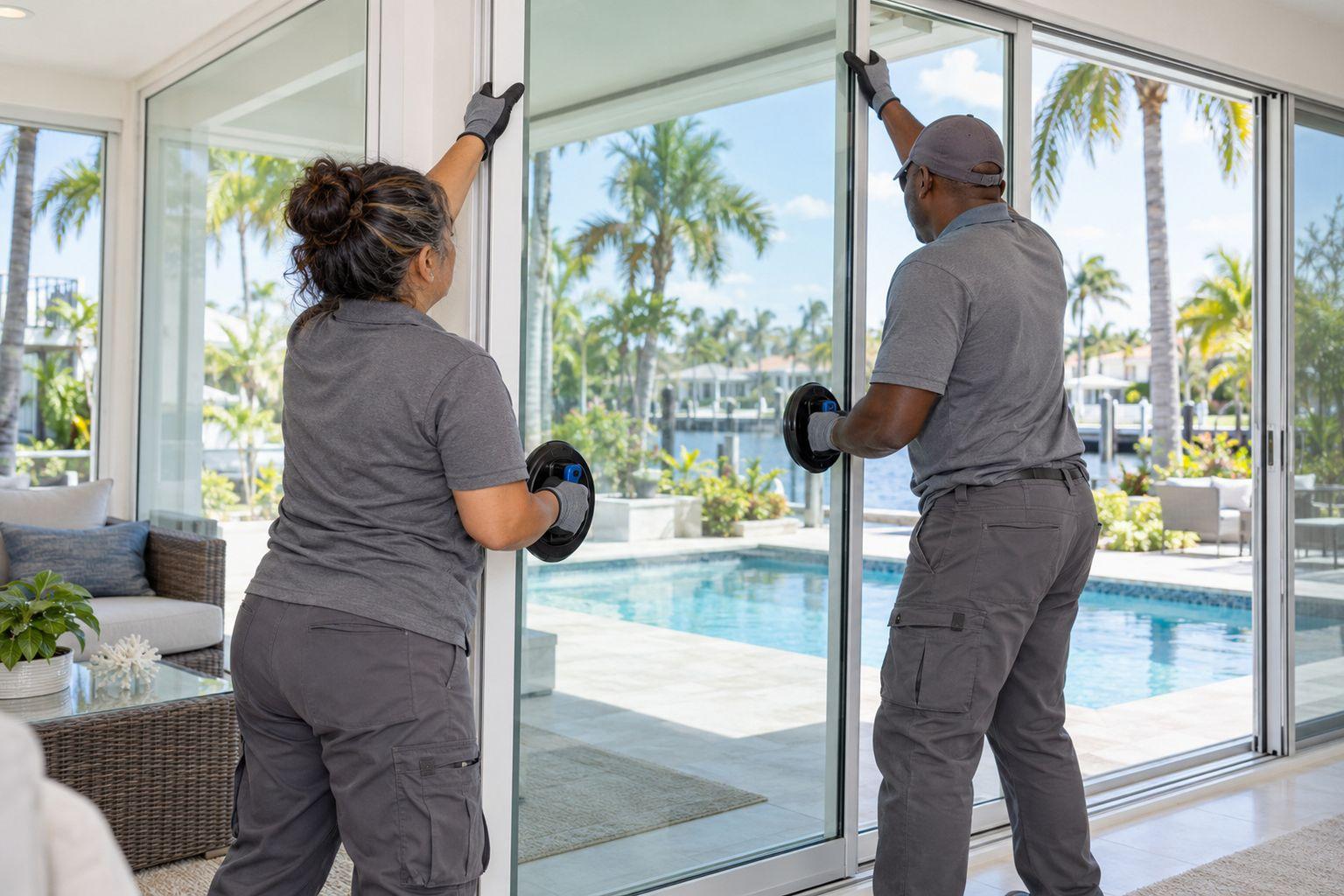
This almost never happens all at once. Rollers wear down, the panel drops a little, and then a bump from a chair or a strong wind gust rocks it out of the groove. Here in Port St. Lucie that wear comes fast. The Atlantic is only a few miles east, so salt-laden air reaches much of the city and corrodes steel rollers and bearings and pits aluminum tracks and sills. Blown sand, grit and pollen pack the track and grind rollers flat. If the door has been grinding and bumping for a season, this is usually the end of that story.
While you wait — please don't
- Stop sliding it. Every push rocks a panel that is no longer held at the bottom and is the most likely way it comes down.
- Do not try to lift it back alone. Re-seating a glass panel is a two-person job, and a single person taking the weight is how panels get dropped and broken.
- Keep children and pets out of the room. A leaning panel can tip without warning, and tempered glass comes apart across the whole floor when it does.
- Do not prop it and leave it. A chair or a broom under the panel holds it only until something knocks it, and the door still needs to be stabilised properly before anyone touches it again.
- Do not use the opening as a doorway. Walking past a loose panel means brushing it, so use another door until a technician has it back on the track.
What the technician does
- The panel is stabilised firstBefore anything else, the technician secures the panel so it cannot tip into the room or drop out of the opening. Nothing else happens until the glass is safe.
- It is lifted and re-seated by two peopleThe panel is raised and set back down with the rollers in the track, with the weight shared so the glass is never carried on one corner.
- Rollers and track are inspectedThe technician looks for what let the door jump in the first place — flattened or seized rollers, a bent or worn track, a pitted sill. Ask to be shown the worn roller and the mark it left in the track.
- Anti-lift blocks are checked and fittedThese sit in the head of the frame and stop the panel being lifted clear of the track. If they are missing or broken, they go back in.
- Header track and roller height are adjustedThe panel is set back to the right height and the header track checked so the rollers sit deep in the groove and the door cannot climb out again.
- The price comes before the workThe technician looks at the door and gives you the price first. You approve it before anything is replaced.
Why this happens in Port St. Lucie, FL
Port St. Lucie housing is dominated by post-1960s single-family homes on slab, with concrete block and stucco walls and sliders onto patios and screened lanais — often more than one set per house. Much of the stock came out of the 1990s and 2000s boom, and the build-out west of I-95 keeps adding more. So technicians here work on forty-year-old aluminum sliders in River Park and Sandpiper Bay and on brand-new units in Tradition and Verano within a few miles of each other. Older single-pane aluminum sliders are still widely in service across Florida, and they are heavy.
The weather drives the timing. Humidity is high year-round, afternoon thunderstorms run June through September, and the Treasure Coast sits in a hurricane corridor — Frances and Jeanne both struck the area in 2004. Wind gusts against a panel already riding on worn rollers are what finish the job. Corrosion-related calls are a year-round staple in this city because salt air, sprinkler overspray and sandy soil never let up on tracks and hardware. Demand across the area rises ahead of and during hurricane season, and again in October and November as seasonal homes are reopened and checked.
Questions people ask
- Can I just push it back on myself?
- Please do not. The panel weighs about as much as a person and there is nothing holding the bottom, so a slip means broken glass in the room. It takes two people and the panel has to be stabilised before it is lifted.
- Why did it come off at all?
- A panel jumps its track when worn rollers let it drop far enough that a bump or a strong wind gust can rock it out. That usually follows a season of grinding and bumping that got put up with.
- Do I need a permit in Port St. Lucie for this?
- Like-for-like repairs such as rollers, track, handles and locks normally require no permit in Florida. Replacing the whole sliding door unit or altering the opening typically does, and the product usually needs a current Florida Product Approval. Your city or county building department can confirm for your address.
- My door is impact-rated. Does that change anything?
- It makes it more important to stop using it and leave it to a technician. Much of coastal Florida requires exterior openings like sliding glass doors to be impact-rated or protected, so the panel and its hardware need to go back the way they were designed to sit.
- Who actually comes out?
- One Call Sliding Door Repair is a referral and scheduling service. We arrange the work with independent local technicians who serve Port St. Lucie — we are not the contractor and we do not perform the work ourselves. Licensing is the technician's own.
One call
Call (888) 851-3682 or send a request through the form on this website, and we will arrange a sliding door technician for your address in Port St. Lucie. The estimate is free, and the technician gives you the price before any work starts so you approve it first.
Something else in this area
- Lock won't catch, handle loose
- Hard to open or close
- Broken or foggy glass
- Rollers worn out
- Bent or worn track
- Drafts, whistling or water coming in
One Call Sliding Door Repair arranges the visit; the technician does the work and gives you the price.