
Lock or handle in St. Petersburg, FL
You push the door shut, flip the latch, and nothing grabs. Or the handle swings loose in your hand and the lock never moves at all. In most cases the lock itself is fine. The panel has dropped a little on worn rollers, so the latch no longer lines up with the keeper in the jamb. Lifting the handle harder to force it will crack the lock body inside the stile, and then you have two repairs instead of one.
Phones answered around the clock · free estimate
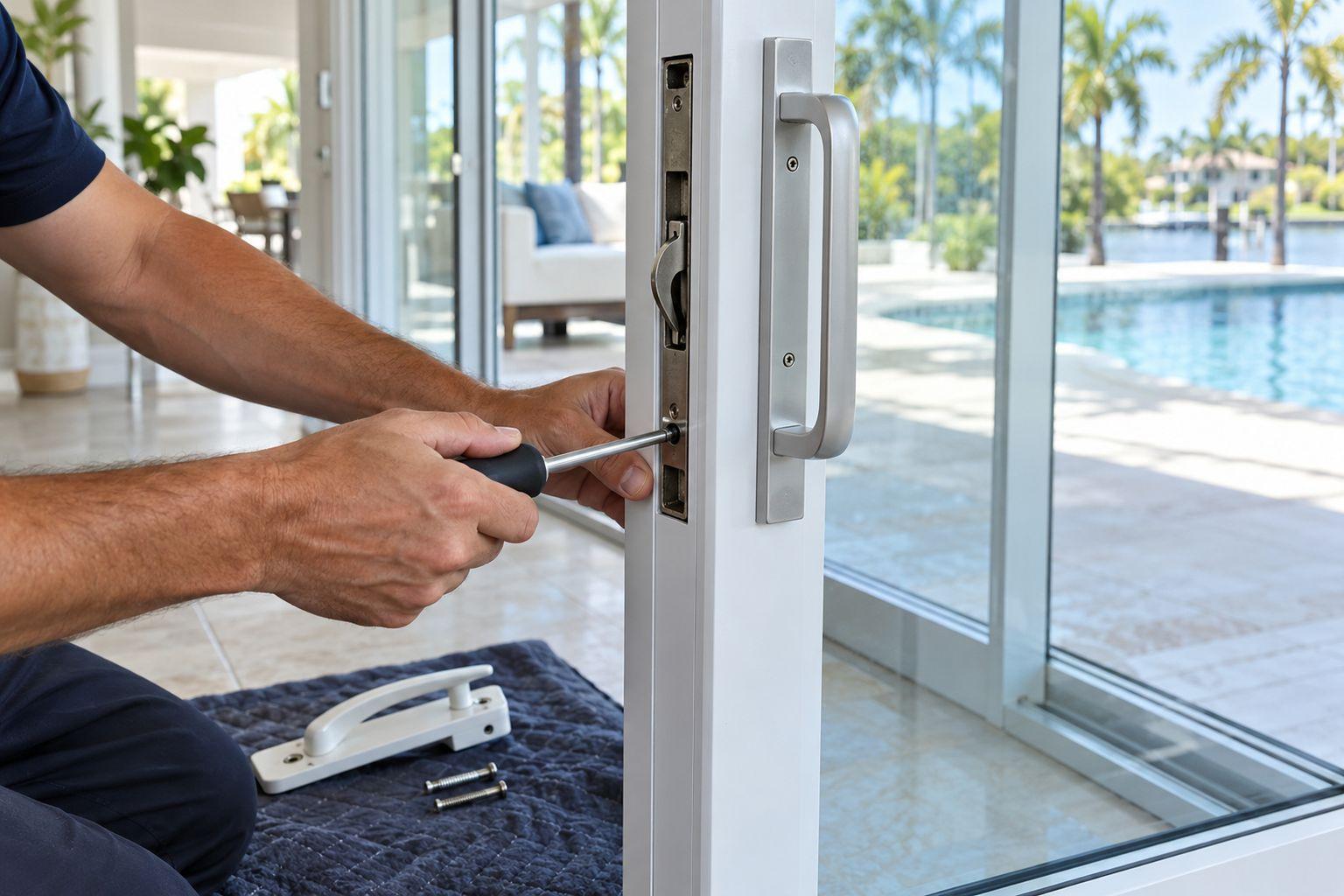
St. Petersburg sits on a peninsula between Tampa Bay and the Gulf, and salt air reaches nearly every property here. Salt corrodes exterior lock cylinders and hardware, and it eats the lock spring and the metal keeper too. The same air pits aluminum tracks and rusts steel rollers and bearings, which is how the panel sags in the first place. Add blown sand and grit packing the track, high humidity year-round, and sun that bows and distorts frames, and a latch that used to catch easily stops lining up.
While you wait — please don't
- Stop forcing the handle. Levering a stiff handle to make the latch catch snaps the lock body inside the door stile, which turns a small adjustment into a hardware replacement.
- Don't leave the door unlocked overnight. A patio door that cannot be locked is an open door, so use a solid wood dowel or bar in the track until the lock is repaired.
- Don't lift the panel out to work on it. A sliding glass panel weighs as much as a person and shatters into the room if you drop it, so stop using the door and leave the panel in place for a technician.
- Don't drill or modify an impact-rated door. Many St. Petersburg doors are impact-rated under Florida's wind-borne debris requirements, and cutting into the frame or fitting the wrong hardware can affect how the opening is meant to perform — leave that work to a technician.
What the technician does
- The rollers get checked firstA lock that stopped catching is usually a panel that has sagged on worn rollers rather than a broken lock. The technician checks roller condition and height before touching the lock.
- Roller height adjustedWhere the latch sits below or above the keeper, raising the panel on its adjusters can bring the two back into line. If the rollers are corroded or ground flat, they are replaced.
- Keeper realigned or replacedThe strike keeper in the jamb is shifted so the latch drops in cleanly. A keeper that is pitted or worn out gets swapped for a new one.
- Lock and handle set replacedMortise locks, keyed locks and handle sets are matched to the door's make, since sliding door hardware is not universal. A flopping handle usually means the internal lock body has given up.
- Secondary locks and foot bolts fittedFor a door that must stay secure, an auxiliary lock or a foot bolt can be added at the top or bottom of the panel.
- Price before any workThe technician looks at the door and gives you the price first. You approve it before anything is started.
Why this happens in St. Petersburg, FL
Salt is the defining maintenance issue in St. Petersburg. Homes a few miles from Tampa Bay or the Gulf see rust on lock hardware and exterior cylinders far faster than inland Florida, and sliding door locks are no exception — the spring inside the lock body and the steel keeper corrode quietly until one day the latch simply will not hold. Neighborhoods close to the water, from Snell Isle and Coquina Key to Shore Acres and the beach-side condo towers, tend to see it sooner. Florida's housing stock leans heavily post-1960, with sliders onto patios, screened lanais, pool decks and balconies, often two or more sets per home, so a worn lock is rarely the only one in the house.
Aluminum-framed sliders are very common here, especially in the 1950s–1970s concrete block and stucco ranch homes and in older coastal and condo construction, and many single-pane aluminum units are still in service. Those frames are the ones most affected by pitted tracks and corroded rollers, which is what drops the panel out of alignment with the keeper. Problems peak in the summer rainy and hurricane season, June through November, when humidity and wind-driven rain are at their worst. There is a second bump from November to April when snowbirds return and open up homes that sat closed, and a lock that worked last spring no longer catches.
Questions people ask
- Is it the lock or the door?
- Most often it is the door. When rollers wear down, the panel sits lower and the latch misses the keeper, so the lock gets blamed. A technician checks roller height and keeper alignment before deciding the lock body needs replacing.
- Do I need a permit for this in St. Petersburg?
- Like-for-like repairs such as replacing rollers, a handle or a lock normally require no permit in Florida. Replacing the whole sliding door unit or altering the opening typically does, and generally needs a product with current approval. Your local city or county building department can confirm for your address.
- Can the keyed lock be matched to my other doors?
- Hardware is matched to the door's make and model, since sliding door locks are not interchangeable the way entry deadbolts are. Ask the technician what options the specific door takes before the work is scheduled.
- Why does my lock keep failing in a few years here?
- Salt-laden air reaches nearly every property in St. Petersburg and corrodes lock springs, cylinders and keepers. Blown sand and grit in the track wear rollers down at the same time, so the alignment slips again. Keeping the track clean helps the rollers last.
- What should I ask the technician?
- Ask to be shown the worn roller or the corroded keeper so you can see the cause yourself. Ask for the reasoning in writing with the estimate. The estimate is free and you approve the price before any work starts.
- Who actually does the work?
- One Call Sliding Door Repair is a referral and scheduling service that arranges sliding door service with independent local technicians across all fifty states. We are not the contractor and we do not perform the work ourselves.
One call
Call (888) 851-3682 or send a request through the form on this website, and we will arrange for an independent local technician to look at your door. The estimate is free, and the price is given and agreed with you before any work begins.
Something else in this area
- Bent or worn track
- Hard to open or close
- Door is off its track
- Broken or foggy glass
- Rollers worn out
- Screen door torn or off
- Drafts, whistling or water coming in
One Call Sliding Door Repair arranges the visit; the technician does the work and gives you the price.